There is some cross-over between STCW and ITU requirements for the minimum number of radio operators required to be on board. In order to avoid any misinterpretation, the minimum number of radio operators on the Safety Radio Certificate Form R is to be entered as “To comply with the Minimum Safe Manning Document”.
Identification and related inspections on the emergency position-indicating radio beacon (EPIRB) (BNR 4.5.2)
406 MHz EPIRBs are to be programmed only with the MMSI number. If the identification is not the MMSI issued by the BMA, the present identification number is to be advised to the Registrar at the BMA office where the ship is registered and the Owner is to be advised that the EPIRB is required to be reprogrammed with the MMSI number.
A short term certificate may be issued, denoting the outstanding deficiency and limiting the validity of the short term certificate to the next port of call where the required equipment is available. In no case shall the interim certificate exceed two months. If the reprogramming cannot be effected within that time, the Owner is to be advised to replace the existing EPIRB with one which is correctly programmed.
The MMSI number issued to vessels registered after 1 January 1993, is located with the call sign at the top right hand corner of the Certificate of Registry. The office of ship registry is denoted on the Certificate of Registry by the prefix to the year of registry. L is London, N is Nassau, NY is New York, HK is Hong Kong.
Watertight Sliding Door Local Operating Handles (BNR 4.2.3)
Watertight door operating handles shall comply fully to the requirements set out in SOLAS in order to ensure uniformity of application. It is possible that confusion to the seafarer may be caused by the utilization of different forms of opening mechanism on different ships. In order to reduce the risk of personal injury or inappropriate operation in case of emergency, the BMA considers that safe operation of watertight doors can only be achieved by using conventional handles as described in SOLAS Chapter II-1.
The display of maneuvering information (BNR4.2.4)
All ships are to display the ship’s maneuvering information according to the requirements in Chapter II-1 of SOLAS and IMO Resolution A.601(15) (Recommendations for provision and display of manoeuvring information on board ships).
Requirements for valves fitted to pipes piercing a collision bulkhead (BNR4.2.5)
SOLAS II-1/12.5.1 requires that any pipe piercing a collision bulkhead is fitted with a screw-down valve capable of being operated from above the bulkhead deck. The BMA concurs with the views of IACS, as outlined in paper SLF/51/3/4 to the IMO Subcommittee on Stability, Loadlines and Fishing vessel safety, that the use of butterfly valves provide a means as effective as a screw-down valve. The fitting of butterfly valves in lieu of screw-down valves on pipes piercing a collision bulkhead is therefore acceptable on Bahamian registered ships.
Interpretation of Dry Cargo Ships defined in SOLAS(BNR 4.2.11)
The BMA notes that “Dry Cargo Ships” are not defined in SOLAS. So, the BMA defines a “Dry Cargo Ship” as “a cargo ship which is not a tanker”.
CO2, Halon and Alternative Gas Fixed Fire Fighting Systems (BNR 4.3.1)
The BMA has issued guidance on the servicing of CO2 cylinders for fixed fire extinguishing installations, low pressure bulk CO2 systems, Halon fire extinguishing systems, alternative fixed gas fighting media and portable fire extinguishers.
Please refer to BMA Information Bulletin No. 97.
Fire Fighting Equipment (Information Bulletin No.97, Revision No.04, Effective date: 13 Feb 2015 )
1. Application
This bulletin applies to all Bahamian ships, except pleasure craft.
2. Inspection, maintenance, testing and survey requirements.
2.1 Notwithstanding the requirements of this Bulletin and the IMO Resolutions and Circulars referred to herein, all inspection, maintenance, testing and survey is to take the relevant manufacturer guidelines into account.
2.2 Certain maintenance procedures and inspections may be performed by competent crewmembers, whilst others should be performed only by persons specially trained in the maintenance of such systems. Any aspect of the testing and maintenance of the system which is assessed by the Company to be beyond the competence of the Company and ship personnel shall be carried out by a competent specialist maintenance firm. Further guidance on competent persons may be found in BMA Information Bulletin No.89.
2.3 The Company shall ensure that the inspection and maintenance of the whole system meets the requirements of the Recognised Organisation and any recommendations of the installation manufacturer or supplier.
2.4 The requirements for Portable Fire extinguishers are contained within IMO Assembly Resolution A.951(23).
2.5 The requirements for fixed CO2 fire extinguishing systems are contained within MSC.1/Circ.1318.
2.6 The requirements for the following fire safety systems are contained within MSC.1/Circ.1432:
Fixed fire detection & alarm systems;
Fixed gas fire extinguishing systems, except fixed CO2 systems;
Fire doors;
Public address & general alarm systems;
Breathing apparatus;
Low location lighting;
Water mist, water spray & sprinkler systems;
Fire mains, fire pumps, hydrants, hoses and nozzles;
Foam fire extinguishing systems;
Firefighters outfits;
Fixed aerosol extinguishing systems;
Portable foam applicators;
Wheeled (mobile) fire extinguishers;
Ventilation systems & fire dampers;
Galley & deep fat cooking fire extinguishing systems;
Fixed dry chemical powder systems;
3.0 Specific requirements for Fixed CO2 Systems
3.1 At least once in any 5 year period all control valves of fixed CO2 systems are to be internally examined.
4. Specific requirement for Halon gas systems
.1 New installations
4.1.1 In accordance with the provisions of SOLAS Chapter II-2, Regulation 10.4.1.3, fire extinguishing systems using Halon 1211, Halon 1301, Halon 2402 and perfluorocarbons are prohibited on all new buildings and new installations on existing vessels.
4.2 Discharge or loss of pressure of existing Halon gas cylinders
4.2.1 In the event of the discharge or loss of pressure of Halon gas cylinder(s), the BMA will accept the replenishment of the discharged cylinder(s), provided that they remain in satisfactory condition.
4.2.2 The safety of the vessel and its crew remains paramount and if Halon gas is not readily available, the Company will be required to ensure that the affected space has adequate temporary fire fighting capability prior to departure from port.
4.2.3 The adequacy of any temporary arrangements and procedures shall be assessed by the Recognised Organisation prior to application for acceptance by the BMA.
4.2.4 Application for acceptance of any temporary arrangements shall be made to the BMA by the Recognised Organisation, in accordance with BMA Information Bulletin No.8, and shall include the items specified in MSC/Circ.775.
4.3 Phase out of Halon gas
4.3.1. There is currently no internationally agreed date for the phasing out of Halon gas, however there may be local or regional regulations that impose restrictions on the use and/or phase out of Halon. The BMA recommends that Companies operating affected Bahamian ships make themselves aware of any restrictions that may be applied by the country or region in which the ship is trading.
4.3.2. Companies operating ships with existing Halon systems should note that the worldwide stock of Halon is diminishing and it is strongly recommended that a plan is implemented for the replacement the Halon system onboard. See IMO Circular FP.1/Circ.44, as amended, for details of the available facilities.
4.3.3. It should be further noted that where Halon replenishment is not permitted by the country or region in which the ship is operating, the ship may be detained and/or prohibited from leaving port until a new fixed firefighting system is installed.
4.3.4. Details of any proposed replacement of a system containing Halon must be forwarded to the BMA for review by the Recognised Organisation.
5. Alternative fixed gas fire fighting media
5.1 Alternative fire fighting systems referred to in SOLAS Chapter II-2 and the IGC Code for protection of machinery and accommodation spaces, pump rooms and cargo spaces may be fitted on board ships, subject to the approval, including any attached conditions, of a Bahamas Recognised Organisation or SOLAS contracting Government. The BMA shall receive prior notification of intention to fit an alternative system which has not been previously accepted by the BMA.
5.2 The BMA accepts the use of (non-asphyxiating) fire extinguishing agents in machinery spaces for which no specific provisions for fire-extinguishing appliances are prescribed under the provisions of SOLAS Chapter II-2, such as “ovec 1230” and “M 200” (HFC-227ea). Acceptance of such agents is subject to conditions, agreed on a case by case basis, appropriate to the space in question and provided that the space is not connected to an accommodation space.
6. Number of portable fire extinguishers and spare charges
6.1 The number of portable fire extinguishers on board should be determined as follows:
6.1.1 Ships built prior to 01 January 2009 – the number of portable fire extinguishers provided is to satisfy the requirements of the relevant Classification Society. In accommodation spaces, service spaces and control stations on ships of 1000 gross tonnage and upwards, no less than five (5) portable fire extinguishers are to be provided. Companies are encouraged to apply the provisions of MSC.1/Circ.1275 where practicable.
6.1.2 Ships built on or after 01 January 2009 – the number of portable fire extinguishers to be provided should be determined in accordance with the Annex to MSC.1/Circ.1275. In accommodation spaces, service spaces and control stations on ships of 1000 gross tonnage and upwards, no less than five (5) portable fire extinguishers are to be provided.
6.2 The minimum number of spare charges carried on board for portable & semi-portable extinguishers shall be in accordance with SOLAS Chapter II-2, namely:
i. 100% for the first ten (10) extinguishers; and
ii. 50% for the remaining extinguishers up to a maximum of sixty (60).
6.3 Additional extinguishers of the same type and capacity shall be carried in lieu of spare charges for any extinguishers which cannot be charged on board ship.
7. Additional Survey Requirements
7.1 In surveying the safety equipment on a vessel, Recognised Organisations shall verify that:
i. all fire fighting equipment has been inspected and maintained in accordance with the manufacturer instructions and the foregoing requirements;
ii. the manufacturer maintenance instructions are on board;
iii. records of inspections, maintenance and pressure tests are maintained; and
iv. spare charges or extinguishers are provided in accordance with paragraphs 6.2 and 6.3, above.
7.2 Recognised Organisations shall refer to the BMA, with relevant recommendations, any cases where a Bahamian ship does not satisfy the foregoing requirements, prior to the issue or endorsement of a Cargo Ship Safety Equipment Certificate, Passenger Ship Safety Certificate or any other statutory certificate that relates to safety equipment (e.g. MODU/MOU certificates).
8. Records
8.1 Records shall be maintained on board of the following inspections & testing:
i. Weekly;
ii. Monthly;
iii. Quarterly;
iv. Annual;
v. Two yearly;
vi. Five yearly;
vii. Ten yearly service;
viii. Other maintenance and testing;
ix. Deficiencies identified and corrective actions performed.
Protection of high pressure fuel pipes (BNR 4.3.2)
The BMA has issued clarification for the requirements of SOLAS Chapter II-2. Refer to BMA Information Bulletin No. 92.
Emergency escape breathing devices (EEBD) ( Rev.No.4/17 Aug 2015)
The BMA has issued clarification for requirements of EEBDs. Refer to BMA Information Bulletin No.29
1.General 1.1 All EEBDs shall comply with the requirements specified in Chapter 3.2.2 of the Fire Safety Systems Code. 1.2 The number and location of all EEBDs shall be indicated on the fire control plan. 2.Carriage Requirements 2.1 SOLAS Chapter II-2, Regulation 13.3.4 specifies the following minimum carriage requirement for EEBDs in accommodation spaces: 2.1.1 Cargo ships: 2 EEBDs; 2.1.2 Passenger ships carrying not more than 36 passengers : 2 EEBDs in each main vertical zone; 2.1.3 Passenger ships carrying more than 36 passengers: 4 EEBDs in each main vertical zone. 2.2 The number of EEBDs in the machinery spaces is provided in guidance of MSC/Circ.1081. 2.3 The Bahamas Maritime Authority(BMA) requires the Company to carry out a risk assessment to determine the location and number of EEBDs required in the machinery spaces. for details of the risk assessment requirements, see information bulletin No.29/4.3. 2.4 The number and location of EEBDs identified by the risk assessment is to be agreed with the CCS responsible for the issue of statutory certificates on behalf of the BMA. 2.5 In the event that the Company and CCS cannot reach agreement on the location and numbers of EEBDs to be provided in the machinery spaces, the BMA will act as the final arbiter. 2.6 All ships shall carry spare EEBDs that shall be located in a control station. Cargo ships and offshore units shall carry a minimum of 1 spare EEBD and passenger ships shall carry a minimum of 2 spare EEBDs. 2.7 In order to satisfy the SOLAS requirements for on-board training in the use of EEBDs, the vessel shall have either: 2.7.1 at least one separate EEBD clearly marked as designated for training; or 2.7.2 facilities to re-instate the EEBD that was used during the training exercise to a fully operational condition (such as means of recharging the cylinder to full operating pressure). 2.8 With respect to Bahamian ships carrying dangerous chemicals in bulk, the BMA will permit the carriage of the emergency equipment specified in either paragraph 14.3.1 of the International Code for the Construction and Equipment of Ships Carrying dangerous Chemicals in Bulk (IBC Code) or paragraph 3.16.10 of the Code for the Construction and Equipment of Ships Carrying Dangerous Chemicals in Bulk (BCH Code), in lieu of EEBDs. 2.9 With respect to Bahamian ships carrying liquefied gases in bulk, the BMA will permit the carriage of the emergency equipment specified in paragraph 14.4.2 of the International Code for The Construction and Equipment of Ships Carrying Liquefied Gases in Bulk 1983, as amended (IGC Code), in lieu of EEBDs. 3.Inspection and Testing 3.1. All EEBDs shall be inspected by a competent person(Refer to BMA Information Bulletin No.89)at least annually. 3.2. Maintenance and servicing of EEBDs shall be carried out in accordance with the manufacturer’s instructions. 3.3. Hydrostatic pressure testing of EEBD cylinders shall be undertaken at least once every five years, or in accordance with the manufacturer’s instructions if such testing is required on a more frequent basis. The test pressure and test date shall be clearly and permanently marked on the cylinder. 3.4. Where EEBDs are fitted with a small capacity oxygen cartridge and manufacturers specify a fixed service life without scheduled hydrostatic pressure testing (e.g. “Ocenco” M-20.2), hydrostatic testing is not required. 4.Records 4.1 Records of inspection, maintenance and testing shall be retained on board for examination. The records must include the test certificates and the inspection status of each cylinder. 5.Survey Requirements 5.1 During Safety Equipment surveys the CCS shall verify that: 5.1.1 the manufacturer’s instructions for the EEBDs are provided and are readily available on board; 5.1.2 the EEBDs have been inspected and maintained in accordance with the manufacturer’s instructions and this Bulletin; 5.1.3 the records of inspection, maintenance and testing are available and up to date; 5.1.4 spare EEBDs are provided in accordance with above-mentioned paragraph 2.6.
Inspection and Testing of Automatic Sprinkler Systems (Bahamas Information Bulletin No.150)
Bahamas Information Bulletin No.150 / Revision No.00?/ Issue Date 02 August 2013
Inspection and Testing of Automatic Sprinkler Systems
1. Purpose
1.1. This Bulletin is intended to provide guidance on the testing requirements for automatic sprinkler systems.
2. Application
2.1. This Bulletin applies to all Bahamian ships fitted with automatic sprinkler systems, such as those required by Regulations 10.4, 10.5 (except when a 揹ry pipe?system is fitted to comply with regulation 10.5.6) & 10.6 of Chapter II-2 of SOLAS 1974, as amended, or similar such systems required for compliance with other IMO Codes.
2.2. This Bulletin does not apply to fixed local application water based fire-extinguishing systems as required by SOLAS Regulation II-2/10.5.6.
3. Definitions
3.1. For the purpose of this Bulletin the following definitions are used, unless expressly provided otherwise:
i) Automatic sprinkler systems ?sprinkler & water-spraying systems required by SOLAS Regulations II-2/10.4, 10.5 and 10.6. This includes fixed pressure 搘ater mist systems?and ?/ins>water spray systems?
ii) Sprinkler ?means sprinkler heads, water mist nozzles or water spray nozzles as applicable to the system in question.
iii) Annual Survey ?means cargo ship safety equipment annual, periodical and renewal surveys; passenger ship safety certificate renewal surveys; and, for other Codes which either refer to SOLAS Regulations II-2/10.4, 10.5 & 10.6, or require similar such systems, their applicable annual, intermediate, periodical or renewal surveys.
4. Background
4.1. IMO Maritime Safety Committee circular MSC.1/Circ.1432, paragraph 7.5.17, recommends an annual operational testing regime comprising of 搮a minimum of two automatic sprinkler heads or automatic water mist nozzles for proper operation? This testing forms part of the annual survey.
4.2. Testing carried out on some passenger ships from May 2012 to May 2013 found that the two sprinklers selected to be tested have both failed to operate at pilot pressure (minimum operating pressure) during testing.
4.3. These failures have led to additional testing which has revealed further examples of sprinklers which failed to operate as required. In some instances, involving 揗arioff Hi-Fog 1000?sprinklers, failure rates of tested sprinklers of up to and in excess of 50% have been found. These failures are not limited to a single design of ship or company抯 fleet.
4.4. Investigations into the causal factors of the operational failures have indicated that water quality has had a significant effect on the condition of the sprinkler body, pistons and 揙?rings.
4.5. Due to the severity of these findings and the need to determine the extent of these failures, the Bahamas Maritime Authority (BMA) has decided to instigate increased testing for Bahamian ships fitted with automatic sprinkler systems where it is identified that there may be an increased risk of failure.
4.6. Testing consists of 揵asic?testing to assess the general condition of the system and 揺xtended?testing where it is necessary to obtain a more detailed assessment of the condition of the system.
5. Recommendations for maintenance of automatic sprinkler systems
5.1. Companies1 operating Bahamian ships shall ensure that the manufacturer抯 inspection and maintenance instructions are incorporated into their Safety Management System.
___________________
1 The 揅ompany?is the entity responsible for the management of the ship in accordance with the ISM Code. For ships which the ISM Code is not applicable, the Company is the Managing Owner in accordance with Section 52 of the Bahamas Merchant Shipping Act.
___________________
5.2. It is recommended that automatic sprinkler system water quality be assessed through periodic sampling and analysis in accordance with the manufacturer抯 instructions.
5.3. Records of automatic sprinkler system water quality should be maintained for monitoring purposes to ensure any deterioration in water quality is identified and to reduce the possibility of damage to sprinklers resulting in failure to operate. Base line water quality should be established at the following times:
Prior to delivery from the building yard, after all installation testing has been completed;
Whenever the system is flushed and re-filled with water in accordance with manufacturer抯 instructions or after operation/testing.
6. Instructions to Recognised Organisation surveyors
6.1. Testing
6.1.1. Testing in accordance with Table 6.1 is to be carried out during the annual survey.
6.1.2. The testing described in Table 6.1 shall be conducted on board during the annual survey with an RO surveyor present.
6.1.3. A significantly increased amount of testing may be required, depending on the results of the basic testing outlined in Annex I of this Bulletin (particularly, but not exclusively, on ships with Marioff Hi-Fog 1000 sprinklers). The Company should ensure that all necessary testing is completed without any detriment to the extent of survey of other items forming part of the annual surveys.
6.1.4. All testing should be completed within 3 months of commencement of basic testing, however, due to the extent of testing that may be required for passenger ships, testing may be commenced up to two months ahead of the start of the PSSC renewal survey window and still be credited towards the subsequent renewal survey, provided all testing is completed by the PSSC renewal due date. The BMA is to be advised by the RO whenever testing is commenced prior to the PSSC window.
Sprinkler Type
Marioff Hi-Fog 1000
Other than Marioff Hi-Fog 1000.
Age of ship
<5 years
Minimum two sprinklers to be operated. Select sprinklers not recently tested or replaced.
If any of these sprinklers fail to operate, continue with testing as described in Annex I.
Minimum two sprinklers to be operated. Select sprinklers not recently tested or replaced.
If any of these sprinklers fail to operate, continue with testing as described in Annex I.
>5 years
Follow the test instructions given in Annex I.
Minimum two sprinklers to be operated. Select sprinklers not recently tested or replaced.
If any of these sprinklers fail to operate, continue with testing as described in Annex I.
Table 6.1 ?Testing Requirements during Annual Surveys.
6.2. Testing at shore side facilities
6.2.1. If, in exceptional cases, it becomes impracticable to do the entire extended testing on board, it may be possible to conduct testing ashore by sending remaining sprinklers for on shore workshop testing. Any requests for shore side testing should be in accordance with paragraph 6.2.2 below.
6.2.2. For extended testing to be carried out at a shore side testing facility, the RO is to make an application containing the fully justified proposal for shore side testing and identification of the testing facility, to the BMA, in accordance with BMA Information Bulletin No.8. The requirements of paragraphs 6.2.3 & 6.2.4 below are also to be addressed in the application.
6.2.3. The following requirements are to be in put in place for shore side testing:
All shore side testing is to be under full supervision of an RO surveyor;
The traceability of the sprinklers shall be maintained throughout the removal/shipping/testing process in such a way that the sprinklers are clearly identifiable with respect to their original position on board;
Custody of the sprinklers shall be controlled in such a way that there can be no suggestion that the sprinklers may have been interfered with prior to testing, or that the testing has been incorrectly carried out;
Sending of sprinklers direct to the manufacturer for unsupervised in-house testing is not acceptable.
6.2.4. Where the shore side test facility is not that of the automatic sprinkler system manufacturer, the details of the test rig and testing procedures shall be reviewed by the RO and confirmed to the BMA as accurately simulating the system on board the vessel.
6.3. Replacement of sprinklers
6.3.1. Where it is necessary to replace all sprinklers the relevant requirements of Annex I are to be followed.
6.4. Reporting requirements
6.4.1. All basic and extended testing is to be reported using the spreadsheet in Annex II of this Bulletin. An electronic copy of this spreadsheet will be provided to all Bahamas ROs for use by surveyors carrying out annual Surveys on Bahamian ships fitted with automatic sprinkler systems.
6.4.2. The completed spreadsheet is to be reviewed by the RO against the appropriate acceptance criteria in Annex I to determine what further action, if any, is to be taken.
6.4.3. Once the action required is determined by the RO, the BMA is to be advised. The submission to the BMA should include the following:
Identification of the ship;
Details of the automatic sprinkler system(s) on board (make, type, etc.);
A written summary of test results;
A copy of the spread sheet;
The RO抯 recommendations for further testing or sprinkler replacement and conditions for issuance of short term certification, as appropriate; and,
The Company抯 intentions for completion of further testing or replacement of sprinklers, as appropriate.
6.4.4. If deemed necessary, the BMA may require the test results to be shared with the system manufacturer and/or the body responsible for issuing the type approval certification for further investigation or comment.
6.5. Short Term Certification
6.5.1. Where the test results require further testing or replacement of sprinklers, the RO is to request permission from the BMA to issue relevant short term certification, in accordance with BMA Information Bulletin No.8.
6.5.2. Where basic testing has been conducted and it is found necessary to undertake extended testing the following conditional text is to be added to the short term certificate:
The automatic sprinkler system is to be subject to extended testing. In the meantime, interim measures to manually activate the sprinkler system pumps from the bridge in the event of a confirmed fire are to be implemented until system functionality has been confirmed. Increased fire patrol activities in affected section(s) are to be implemented and details of fire patrols recorded.
6.5.3. Where extended testing has been conducted and it has been found necessary to replace sprinklers, depending on the agreed corrective actions one of the following conditional texts is to be added to the short term certificate:
Option 1: The automatic sprinkler system sprinklers in [state sections] are to be renewed. In the meantime, interim measures to manually activate the sprinkler system pumps from the bridge in the event of a confirmed fire are to be implemented until system functionality has been confirmed. Increased fire patrol activities in affected section(s) are to be implemented and details of fire patrols recorded.
Option 2: The automatic sprinkler system is to be subject to further testing limited to 30% of the total number of sprinklers in the affected sections. The test results should then be reassessed with all sprinklers tested in the section in question. In the meantime, interim measures to manually activate the sprinkler system pumps from the bridge in the event of a confirmed fire are to be implemented until system functionality has been confirmed. Increased fire patrol activities in affected section(s) are to be implemented and details of fire patrols recorded.
7. Revision History
Rev.0 (02 August 2013) ?First issue
Annex I – Test Procedures
Basic testing
1.牋 The purpose of basic testing is to determine the general condition of the sprinkler system and consists of testing of a limited number of sprinklers and taking of water samples from the system.
2.牋 Basic testing is to be carried out at the system抯 pilot pressure (minimum operating pressure). The pilot pressure is to be ascertained from the system manuals.
3.牋 A minimum of two sprinklers in at least 10 sprinkler sections (20sprinklers in total) should be tested. The test samples should be taken from different areas of the ship. For consistency, it is important that at least two sprinkler tests are recorded and documented from any tested section.
4.牋 For vessels with a combination of Marioff Hi-Fog 1000 and 2000 sprinklers or Marioff Hi-Fog 1000 and another manufacturer抯 sprinklers, only 2 out of the 20 sprinklers should be of the Marioff Hi-Fog 2000 or the other manufacturer抯 sprinklers.
5.牋 Water samples are to be taken in accordance with paragraphs 18 & 19.
6.牋 The test results should be recorded in accordance with paragraph 6.4 of BMA Information Bulletin No.150 and compared to the acceptance criteria defined in paragraphs 7, 8 & 9.
Basic testing acceptance criteria
7.牋 If 0, 1 or 2 (≤10%) of the sprinklers fail to operate at the pilot pressure, no further action is required and the situation will be monitored by new tests at the next annual survey.
8.牋 In the special case of 2 sprinklers from the same sprinkler section failing, it should be ensured that the remaining sprinklers in the same section are not impaired. Typically, an additional 10 sprinklers should be tested in the same section. If 2 or more of the additional sprinklers fail the test, the section is to be deemed contaminated and all sprinklers within that section should be replaced.
9.牋 If three or more sprinklers out of the 20 sprinklers tested fail (>10%) an extended test programme in accordance with paragraphs 10, 11, 12, 13 & 14 below should be initiated.
Extended testing
10.?The purpose of extended testing is to determine in more detail either the general condition of the automatic sprinkler system or the condition of each individual sprinkler section. Based on the results of the test a decision can be made whether sprinkler sections may be left in service or whether replacement is needed.
11.?Based on the results from basic testing the following extended test programme in Table 11 is implemented:
Case
Failure rate, RFB, from basic testing
Additional number of sprinklers to be tested.
i
10% <RFB≤ 20%
Minimum 2 sprinklers to be tested from sprinkler sections selected as follows:
●? If number of sections <20, test all sections;
●? If number of sections is between 20 and 40, test 20 sections;
●? If number of sections >40, test 50% of the sections.
ii
RFB>20%
Minimum 7 sprinklers from each sprinkler section. All sprinkler sections to be tested except for sections where the Company prefers to replace all sprinklers at this stage.
Table 11 ?Extended testing requirements.
12.?Extended testing is carried out at pilot pressure. In cases where sprinklers fail to operate at pilot pressure the actual opening pressure should be ascertained but in no circumstances should the sprinkler be tested to a pressure greater than the maximum operating pressure identified by the system manufacturer.
13.?Water samples are to be taken in accordance with paragraphs 18 & 20.
14.?It is recommended that the basic and extended tests are carried out within 3 months of the commencement of basic testing. The test results should be recorded as per Paragraph 6.4 of Bulletin No.150 and checked with regard to the acceptance criteria in paragraphs 15, 16 & 17.
Extended testing acceptance criteria
15.?A case by case review should always be carried out taking into account the failure rate at the pilot pressure, the actual opening pressure, number of sprinklers within the protected spaces in question (e.g. only 1 sprinkler installed being more critical than 20), number and percentage of sprinklers tested in the section in question and water quality.
16. Case i (from Table 11):
If ≤10% of all sprinklers tested failed to operate at the pilot pressure, no further action is required and the situation will be monitored by new tests at the next annual survey (but see paragraphs 21, 22 & 23 below).
In the special case where both sprinklers in a single section fail, it should be ensured that the remaining sprinklers in this section are not impaired. Typically, another 10 sprinklers should be tested in that section, of which 9 should operate as required. If 2 or more of these additional sprinklers fail the test, the section is deemed contaminated and all sprinklers within that section should be replaced.
If >10% of all sprinklers tested fail to operate at the pilot pressure the test programme should be extended to comply with paragraph 17 (case ii) below.
17. Case ii (from Table 11):
Each section is assessed and for sections with a failure rate at or below 15%, no further action is required and the situation will be monitored by new tests at the next annual survey.
For sections with a failure rate above 15%, all sprinklers within that section should be replaced.
Alternatively, if the number of sprinklers tested in that particular section represents less than 10% of all sprinklers installed in this section, further testing limited to 30% of the total number of sprinklers in that section may be carried out and the results can be reassessed with all sprinklers tested in that section being considered. The acceptance criterion still remains at or less than 15%.
Water samples
18. It is recommended that water samples are taken from the sprinkler tank, pump unit and relevant sections (as close as practicable to the sprinkler as this represents the water in the branch pipe).
19. If only basic testing is required, the samples can be taken and analysed on board by the crew.
20. If extended testing is required, it is recommended that a test laboratory is employed for the analysis of the water samples.
Water sample acceptance criteria
21. The water quality is to be assessed against the system manufacturer抯 water quality requirements and should address, as a minimum:
pH;
chloride content;
conductivity of the water.
Water test results are to be reported to the BMA in accordance with paragraph 6.4 of BMA Information Bulletin No.150.
22.It must be remembered that the water may have been exchanged and that the system may have been charged with better or worse water in the past.
23.If water samples of certain areas are found not to be in compliance with the manufacturer抯 recommendations for water quality, replenishment of the water in the tanks and thorough flushing of all pipes in the affected sections should be conducted. It is of the utmost importance that the manufacturer抯 water specifications are followed in order to prevent progressive damage to sprinklers.
Replacement of Sprinklers
24. If replacement of all sprinklers in a section is required, care should be taken to ensure that all contaminated water is drained from the piping.
25. Sprinklers should be removed from all branch piping and all piping should be blown through with air, or flushed properly with water complying with the manufacturer抯 recommendations.
26.Replacement sprinklers are to be of the correct type and approved for use in the system. Unapproved modifications to the system or sprinklers will render the system抯 Type Approval invalid.
27.Where extensive replacement of sprinklers is required a replacement plan is to be submitted to the BMA by the RO, in accordance with paragraph 6.4.3 of BMA Information Bulletin No.150.
Annex II
Example of Results Spread sheet
Observations/
Comments
Date
?/span>Tested
Water sample
Chlorides
ppm
Conductivity
μS/cm
pH
Filter
?/span>Condition
Sprinkler
?/span>Distance
?/span>from mail line(m)
Actual
?/span>Release
?/span>pressure
Release
?/span>at pilot pressure?
Y/N
Position
?/span>Relative
?/span>to section
?/span>valve
Sprinkler
?/span>Data
Area
MVZ
Deck
Section
Test
?/span>No.
1
2
3
4
5
6
7
8
9
10
11
12
13
14
15
16
17
18
19
20
Servicing of inflatable LSA (BNR 4.4.1)
Refer to BMA Information Bulletin No. 98.
LSA fall wires (BNR 4.4.2)
Further information regarding maintenance and renewal of wire for for lifeboat falls and appliance-launched liferafts is available in BMA Information Bulletin no. 100.
Safety of lifeboats during abandon ship drills (BNR 4.4.3)
The Master has discretion to modify or postpone drills which are required under SOLAS Chapter III though the justification is to be entered into the Official Log Book and the required drill has been carried out at the earliest practical opportunity thereafter.
Refer to BMA Information Bulletin No. 72.
Refer to the following BMA Information Bulletin no. 87.
Safety of Survival Craft On-load Release Gear and Launching Appliance
BMA Bulletin No.87
Revision No.04
Issue Date 16 Aug 2012
1. Purpose
1.1 The issue of survival craft safety remains a significant concern and the IMO Maritime Safety Committee (MSC) has, following discussion, issued IMO Circulars MSC.1/Circ.1206 Rev.1 “Measures to Prevent Accidents with Lifeboats” and MSC.1/Circ.1277 “Interim Recommendation on Conditions for Authorisation of Service Providers for Lifeboats, Launching Appliances and On-Load Release Gear”.
1.2 This Bulletin is intended to clarify the policy of The Bahamas Maritime Authority (BMA) on the application of SOLAS Regulations III/20.3 and III/20.11 and the associated IMO circulars, in light of on-going discussion at IMO.
1.3 This Bulletin is to be read in conjunction with BMA Information Bulletin No. 72 and IMO Circulars MSC.1/Circ.1206 Rev.1 and MSC.1/Circ.1277.
2. Application
2.1. This Bulletin applies to the following:
All ships’ lifeboats and rescue boats fitted with on-load release gear as referred to in SOLAS III/20.11.2;
All ships’ davit launched liferaft automatic release hooks as referred to in SOLAS III/20.11.3;
All ships fitted with survival craft launching appliances as referred to in SOLAS III/20.11.1.
3. SOLAS Regulations III/20.3 & III/20.11
3.1. SOLAS Regulation III/20.3
3.1.1. This Regulation refers to maintenance, testing and inspections of all life-saving equipment and requires that these activities are carried out based upon the guidelines contained in MSC.1/Circ.1206 Rev.1.
3.1.2. It must be noted that specific requirements regarding annual thorough examination and testing of launching appliances and on-load release gear are contained within SOLAS Regulation III/20.11.
3.2. SOLAS Regulation III/20.11
3.2.1. Periodic servicing – this Regulation requires:
i. annual thorough examination and operational test of launching appliances and on-load release gear, and,
ii. at least every five years, overhaul of on-load release gear (for lifeboats and rescue boats) and automatic release hooks (for davit-launched liferafts) and load testing.
3.2.2. The maintenance required by SOLAS III/20.11.1.1, 20.11.2.1, and 20.11.3.1 is not required to be carried out in conjunction with annual, periodic or renewal survey, but it must be verified at the time of survey. The BMA advises that the required maintenance may be harmonised with the survey window in order that the principles set out in MSC/Circ.955 can be applied. This will provide a practical framework for implementation when applying a 12 month maintenance period.
4. Status of MSC.1/Circ.1206 Rev.1
4.1. SOLAS Regulation III/20.3.1 states that “…maintenance, testing and inspections shall be carried out based on the guidelines…” (IMO Circular MSC/Circ.1206 Rev.1). Companies1 should take into account the existing guidance in the context of their obligations under ISM Code.
5. Requirements for personnel performing inspection, servicing and repair
5.1. The BMA does not authorise or approve service providers unless they are based in The Bahamas.
1 The “Company” is the entity responsible for the management of the ship in accordance with the ISM Code. For ships which the ISM Code is not applicable, the Company is the Managing Owner in accordance with Section 52 of the Bahamas Merchant Shipping Act.
5.2. In line with the responsibilities specified in Annex 1 paragraph 6 of MSC/Circ.1206 Rev.1 the Company is responsible for assessing and selecting a suitable competent person, and appropriate procedures relating to this activity must be established within the Safety Management System.
5.3. The Company should ensure that documentary evidence is available to third parties to confirm that the competent person carrying out the service, maintenance, repair, and inspection and examination activities covered by SOLAS Regulation III/20.11 is properly trained and familiar with these duties.
5.4. For the purposes of SOLAS Regulation III/20.11, the BMA considers that “properly trained personnel familiar with the system” may be:
i. representatives of the manufacturer; or
ii. a person trained by the manufacturer; or
iii. representatives of an organisation authorised or certified by the manufacturer; or
iv. representatives of an organisation authorised under the provisions of MSC.1/Circ.1277 by a SOLAS contracting party or a Bahamas Recognised Organisation acting on behalf of a SOLAS contracting party; or
v. Other persons with proven experience in conducting this type of work. The selection of persons in this category is the responsibility of the Company and the criteria and procedures for selection should be documented in the safety management system and take into account the following:
Existing Flag State or Recognised Organisation approvals;
Existing manufacturer approvals;
Suitable training programmes for operators/technicians/inspectors;
Review of servicing records/history for similar equipment;
Access to spare parts and servicing instructions;
Any quality management system certification, such as ISO 9000 series or equivalent.
6. Records
6.1. Records of all activities relating to the referenced regulations must be retained on board for inspection by Bahamas Approved Nautical Inspectors, Recognised Organisation Surveyors/Auditors and Port State Control Officers.
7. Revision History
Rev.4 (16 August 2012) – Complete revision
Replacement of lifeboat on-load release gear (BNR 4.4.7)
The BMA has allowed the replacement of existing lifeboat on-load release gear with a modern, more stable arrangement. IMO has formalised these procedures in MSC.1/Circ.1392, which should be followed. Any deviations from the procedure outlined in MSC.1/Circ.1392 will be agreed on a case by case basis.
The BMA will give consideration to accepting the installation of new Release and Retrieval Systems (RRS) which are not manufactured by the original lifeboat manufacturer provided the following is undertaken:
1) It is demonstrated that the original lifeboat manufacturer is no longer in existence; or,
2) At least three attempts have been made by the owner to obtain the agreement of the original lifeboat manufacturer to the installation of the proposed RRS.
If no response is received from the original lifeboat manufacturer, or the lifeboat manufacturer objects , the review and approval of the RRS installation may be carried out by the Recognised Organisation in accordance with the procedures in the MSC.1/Circ.1392.
Equivalent arrangement of life-saving appliances (BNR 4.4.6)
The Bahamas has submitted the following arrangement to IMO (IMO SLS Circ. 14/22):
Cargo vessels of 500 gross tons and over, but less than 1,600 gross tons, except tankers, may be equipped as follows:
a. On one side of the ship, a motor lifeboat complying with the standards required for rescue boats, which are to be fitted under an approved launching device. Such motor lifeboat is to be available for immediate use at all times during any voyage. In addition, if the motor lifeboat is not of such capacity to accommodate all on board, one or more life rafts of sufficient aggregate capacity (in conjunction with the capacity of the motor lifeboat) to accommodate the total number of persons on board;
b. On the other side of the ship, one or more lifeboats or inflatable life rafts of sufficient aggregate capacity to accommodate the total number of persons on board. If a lifeboat is fitted, it is to be fitted under an appropriate launching device;
c. In ships where the distance from the embarkation deck to the water in the lightest sea-going condition exceeds 15 feet (4.5 meters) the life rafts required above are to be of the davit launched type and at least one launching device is to be provided on each side of the ship for every two life rafts. The launching device is to be capable of lowering the life raft when fully loaded with its full complement of persons and equipment;
d. In addition to any life rafts required by a. and b. above, further life raft(s) of sufficient aggregate capacity to accommodate at least the total number of persons on board, which life raft(s) are to be stowed as to be able to float free;
NOTE: Each life raft required by Sections a, b, and d above, is to be of approximately the same capacity.
Ships which have arrangements in accordance with the provisions of IMO SLS Circular 14/22 are to if applicable, comply with the requirement to be fitted with a rescue boat.
The provisions of IMO SLS Circular 14/22 are not to apply to any ship with date of keel laid on or after 01 July 2007.
Testing of lifeboats (BNR 4.4.7)
The sister ship rule may be applied to the 5 knot launch test required by LSA Code 5.1.4, whereby the test is only necessary for the first vessel of a contracted series of ships with identical arrangements, and where the geometry of the lifeboat launching arrangement is also verified as being identical to the first vessel which has been satisfactorily tested.
Immersion suits onboard cargo ships (BNR 4.4.8)
Refer to BMA Information Bulletin No.76.
Exemption from the carriage of lifeboat food rations and fishing tackle (BNR 4.4.9)
All vessels which operate solely within 200 miles from shore may be exempted from the carriage of lifeboat rations and fishing tackle under the provisions of LSA Code 4.4.8.32.
Applications for exemption are to be submitted by the Recognised Organisation in accordance with the guidelines outlined in BMA Information Bulletin No. 8.
Applications relating to offshore units operating outside the 200 mile limit and those undertaking positioning and delivery voyages which take them beyond the 200 mile limit shall be referred to the BMA for consideration on a case by case basis.
Carrying capacity of liferafts – average mass of occupants 82.5kg (BNR 4.4.11)
In accordance with Chapter IV of the LSA Code, from 01 January 2012 all inflatable and rigid liferafts should be constructed using the assumption that the average mass of occupants is 82.5kg, increased from 75kg.
All ships constructed (having their keel laid) on or after 01 January 2012 should carry liferafts approved on the basis of an average person mass of occupants of 82.5kg. The safe working load (SWL) of any davits used for launching these liferafts should be adequate for their fully laden weight.
All ships constructed before 01 January 2012 may continue to use liferafts approved on the basis of an average person mass of occupants of 75kg. It is acceptable for “75kg liferafts” on these vessels to be exchanged at service intervals with “82.5kg liferafts” and vice versa at a subsequent service. It is also acceptable for these vessels to have both 75kg and 82.5kg liferafts on board at the same time.
On passenger ships constructed before 01 January 2012, IMO MSC circular MSC.1/Circ.1347 permits the determination of the required SWL of a liferaft launching appliance to continue to be based on an assumed occupant mass of 75kg, even though the liferaft has been tested to a higher weight standard. The installation and periodic lowering test should also continue to be based on an assumed occupant mass of 75kg. On cargo ships constructed before January 1, 2012, any liferaft launching appliance should be based on the occupant number and mass stated on the liferafts it will handle (i.e. 75kg or 82.5kg, as applicable). If the SWL of the launching appliance will be exceeded through the liferaft having been approved to a higher weight standard then it will be necessary for the davit to be reapproved, modified or replaced to achieve the required SWL.
Use of knotted ropes as a means of embarkation to remotely located liferafts (BNR 4.4.10)
SOLAS Chapter III Regulation 11.7 allows for “other means of embarkation enabling descent to the water in a controlled manner” for liferafts required by SOLAS Chapter III Regulation 31.1.4.
The BMA considers that “other means of embarkation” refers to systems such as descent units, escape chutes etc. Knotted ropes are not acceptable for this purpose.
Carrying capacity of liferafts 閳?average mass of occupants 82.5kg (BNR 4.4.11)
Bahamas INFORMATION BULLETIN No. 117
1. Purpose
1.1. This Bulletin is intended to support existing advice and guidance issued by the Bahamas Maritime Authority (BMA) related to enhancing the safety of personnel when using lifeboats which feature on-load release gear. Since this Bulletin was first issued in August 2008, the use of Fall Preventer Devices (FPDs) has been considered at IMO and detailed guidance is available in Maritime Safety Committee (MSC) circular MSC.1/Circ.1327.
1.2. This Bulletin should be read in conjunction with MSC Circulars MSC.1/Circ.1327 and MSC.1/Circ.1206 Rev.1.
2. Application
2.1. This Bulletin applies to the following:
?span style=’font:7.0pt “Times New Roman”‘> All ships鈥?lifeboats and rescue boats fitted with on-load release gear as referred to in SOLAS III/20.11.2;
?span style=’font:7.0pt “Times New Roman”‘> All ships鈥?davit launched liferaft automatic release hooks as referred to in SOLAS III/20.11.3;
?span style=’font:7.0pt “Times New Roman”‘> All ships fitted with survival craft launching appliances as referred to in SOLAS III/20.11.1.
3. Accidents with lifeboats
3.1. While the number of accidents remains small in comparison with the number of Bahamian ships, the consequences of accidents can be unacceptably high. With this in mind, measures have already been implemented to limit the exposure of crews to the hazard associated with on-load release gear failure by allowing lifeboats to be initially lowered and recovered without personnel onboard during drills.
4. Replacement of hook arrangements
4.1. In recognition of the problems associated with this matter, the BMA has agreed procedures with some Recognised Organisations to facilitate the retrofit of modern designs of on-load release gear which feature enhanced safety. All Owners of Bahamian ships are encouraged to assess existing hook arrangements on board in order to identify where improvements, if any, can be made
5. Interim safety measures
5.1. The BMA has noted that the use of fall preventer devices (FPDs) has been implemented on many vessels. The use of FPDs allows lowering and recovery of the boat with personnel inside, with enhanced safety and familiarisation benefits.
5.2. FPDs are intended to protect against the consequences of an unintended release of the hook(s). The safety pin type consists of a steel pin which passes through the cheek plates of the release gear to physically prevent the hook from releasing by locking it in the engaged position and many modern designs now feature such safety pins.
5.3. An alternative method used for older designs which do not feature safety pins is to fit resilient strops or continuous slings across the on-load release between a fixed strong point on the lifeboat and the falls block ring or shackle. The resilient FPD will not prevent the on-load release gear from releasing but will prevent hazardous consequences.
5.4. The BMA recognises the overriding authority and the responsibility of the Master to make decisions with respect to safety, as set out in Paragraph 5.2 of the ISM Code and consequently accepts the use of FPDs when advocated by the Company.
5.5. Where FPDs are used, procedures for their use, inspection and maintenance shall be made available to ship鈥檚 crew and documented in the ship鈥檚 Safety Management System. The professional judgement of the Master is necessary in deciding the occasions and circumstances when FPDs are installed and used, such as when the suspension hooks of the craft cannot be secured in a fail-safe condition (i.e. 鈥渃losed鈥? when at any significant height above the water.
5.6. The BMA has no objection to the use of FPDs on Bahamian ships in association with any safety drill or exercise.
6. Using fall preventer devices
6.1. Any FPD installed shall be fit for purpose. The proposal to use such a device shall be subject to an engineering analysis to ensure that the device and existing lifeboat structure and arrangements are capable of withstanding any loadings which would result from the failure of the onload release gear with the boat in the fully-loaded condition and suspended from the davits. A factor of safety of six (6) should be the minimum used in such an analysis. All materials used shall be suitable for use in the marine environment.
6.2. Wires or chains shall not be used as FPDs as they do not absorb shock loads.
6.3. Resilient FPDs shall be continuous slings or strops of a type which have permanent end loops and shall be of a suitable length to ensure minimal drop in the event of premature release of the hook arrangement. Strops shall be dedicated to lifeboat use and should be suitably identified to ensure that they are not used for any other purpose.
6.4. Continuous slings have an advantage over strops in that they possess fewer points of splicing (potential failure points) and can be arranged in shorter lengths. They can also be released in an emergency (when waterborne) by cutting a single member of the sling.
6.5. All such FPDs should be protected by an outer cover that protects them from damage or degradation from chemical contamination or ultra-violet light. The outer covering should not be contributory to the overall tensile strength of the sling or strop.
6.6. In selecting FPDs, the Company shall ensure that a comprehensive risk assessment is carried out to ensure that nothing is done to compromise the effectiveness of the operation of the release gear. This is particularly important where the installation of a safety pin is considered. The Company shall not make any modification which adversely affects the strength and type approval of the hook and release gear arrangement.
6.7. Where FPDs fitted are synthetic strops or slings, a functional test should be carried out. The function test should demonstrate, to the satisfaction of the Recognised Organisation surveyor, that the equipment performs without interfering in the operation of the lifeboat or launching equipment. The function test is to be carried out at the first Safety Equipment Annual Survey or PSSC Renewal Survey after the date of issue of this bulletin and thereafter at the subsequent 5 yearly load test and thorough examinations as required by SOLAS Ch.III, Reg.20.11.
6.8. Companies shall ensure that suitable procedures are implemented to ensure that individuals involved in the lifeboat launching are fully trained, familiar and competent in the maintenance, inspection, installation and removal of FPDs. All FPDs should be thoroughly examined prior to each use and replaced if any signs of damage or significant deterioration are found. The Company should also establish a schedule for overload testing and replacement.
6.9. Where FPDs are used, suitable clear and simple warning notices should be placed inside the lifeboat at the release gear access hatches at each end of the boat so as to ensure correct use of the devices.
7. Examples of FPD
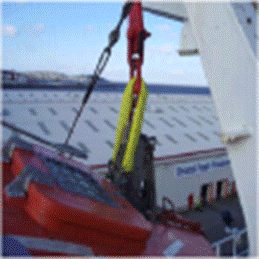
Figure 1 鈥?Continuous sling in place over-riding on-load release
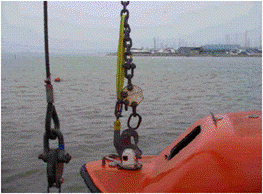
Figure 2 – FPD taking load during exercise, simulating premature release of onload hook. Note that the boat is not waterborne but suspended just above the water 鈥?a safety precaution for avoiding injury to personnel or damage to
structures during the exercise.
Wires for Lifeboat, Rescue Boat and Appliance Launched Life Rafts Falls(BMA Information Bulletin No.100 Rev.02)
.1 These requirements apply to the wires used on lifeboats, rescue boats and appliance-launched life rafts on all Bahamian ships.
.2 Turning of Wires End-for-end
Falls used in launching shall be inspected periodically and renewed when necessary due to deterioration or after not more than 5 years, whichever is earlier. The previous requirement for wires to be turned end-for-end at intervals of not more than 30 months and renewed after no more than 5 years is no longer applicable, however Regulation 20.4 does not prohibit turning of wires end-for-end.
If the Company (owner or any other organization or person, such as the manager, or the bareboat charterer, who has assumed responsibility for the operation of the ship) choose to end-for-end falls wires, special attention must be paid to the method of joining and terminating wires. BMA recognizes that there are a number of alternative methods that can be used to form these terminations and that the suitability of each type of connection for the intended service is varied. The company shall ensure the correct method of joining and terminating the wires, taking into consideration any design or manufacturers’ requirements.
.3 The falls used in launching shall be inspected periodically (i.e. at least annually) with special regard for areas passing through sheaves. The acceptance of the periodic inspection is on the basis that the falls will be renewed when necessary due to deterioration of the falls or at intervals of not more than 5 years, whichever is earlier. The periodical inspection shall be carried out by competent persons within the window before, or at the time of, the Safety Equipment survey.
The periodic inspection of every wire shall at least comply with the following specification:
The survival craft must be lowered to the water or the wire otherwise paid out, such that the wire bears no weight and there is no more than one layer left on the drum. The wire shall then be cleaned to facilitate a general inspection of its condition. The stationary parts of the wire, i.e. parts resting on or within sheaves and locking devices, must be given particularly close attention during that inspection. Once the wire is clean it must be verified as free from corrosion and that grease had penetrated the whole wire. In the case of anti-rotational wires or wires with sheathed cores, the inspection, maintenance and effectiveness of greasing is to be determined in accordance with manufacturer’s instructions. After satisfactory inspection an approved type of grease shall be re-applied in accordance with manufacturer’s instructions and the wire re-wound on the drum as recommended by the manufacturer.
Wires found with corrosion or deterioration to the extent that their strength is compromised must be replaced.
.4 Stainless Steel Falls
Where no service life for marine use is specified by the manufacturer, stainless steel falls are subject to the same requirements as galvanized steel falls. Where the manufacturer’s stated service life for marine use exceeds five years the wire may be retained in use for the stated period subject to being turned end-for-end as specified by the manufacturers and to periodic inspections as set out above.
.5 Record Keeping
Instructions, maintenance and record keeping shall be implemented through the ship’s instructions for on-board maintenance of life saving appliances or a planned maintenance system which meets the requirements of SOLAS Chapter III. Records must clearly state that the annual periodical inspection has been carried out and the results of the examination. If end-for-end turning of wires has been carried out this should also be recorded. The renewal of falls at the required intervals (according to the maintenance procedure adopted) must be included. These records must be verified by the surveyor attending for the Safety Equipment Survey.
Inspections on the visibility at the wings of the bridge (BNR 4.6.3)
Ships constructed prior to 01 July 1998 which undergo repairs, alterations and modifications of a major character (according to the criteria in IMO Maritime Safety Committee (MSC) Circular MSC/Circ.1246) shall comply to the maximum extent practicable with the requirements of SOLAS Chapter V requirements. Any areas of noncompliance shall be brought to the attention of the BMA.
Requirements on the bridge height of eye (BNR 4.6.4)
Current SOLAS requirement for bridge height of eye is to be 1,800mm. There is a provision under SOLAS to reduce the height of eye to 1,600mm.
In view of the possibility of crews changing and available statistics showing a distinct trend for all nationalities becoming taller in the near future, newly constructed vessels are to comply fully with SOLAS Chapter V requirements and there is generally no allowable reduction in height of eye from the 1800mm standard.
Exceptions will be considered by the BMA for special type ships with unique construction features and ships which have been constructed to the standards of another SOLAS contracting State.
Tests and drills on steering gears (BNR 4.6.5)
For ships regularly engaged on voyages of short duration, SOLAS Chapter V requirements to carry out the checks and tests may be waived, as provided for in the regulations, provided that those checks and tests are carried out at least weekly.
Tests and drills on steering gears (BNR 4.6.5)
For ships regularly engaged on voyages of short duration, SOLAS Chapter V requirements to carry out the checks and tests may be waived, as provided for in the regulations, provided that those checks and tests are carried out at least weekly.
Long Range Identification and Tracking of Ships (LRIT) Bulletin No. 111 Revision No. 05
1. Application
The LRIT requirements entered into force on 01 January 2008 and the requirement to fit LRIT equipment is applicable to the following Bahamian ships engaged on international voyages, unless the vessel is operating exclusively in a GMDSS A1 sea area and is fitted with an Automatic Identification System (AIS):
:
i. Cargo ships, including high speed craft of 300 gross tonnage and above;
ii.All passenger ships, including high speed passenger craft;
iii. Mobile Offshore Drilling Units (MODUs) that are propelled by mechanical
means;
iv. Offshore support vessels, Special Purpose Ships and Mobile Offshore Units
(MOUs) of 300 gross tonnage and above that are propelled by
mechanical means;
v. Commercial yachts of 300 gross tonnage and above.
2.Definitions
For the purpose of The Bahamas requirements for LRIT, and notwithstanding the definitions provided in the SOLAS regulations and IMO guidelines, the following terms apply:
· Company is the entity responsible for the management of the ship in accordance with the ISM Code. For ships which the ISM Code is not applicable, the Company is the Managing Owner in accordance with Section 52 of the Bahamas Merchant Shipping Act;
· Conformance test result is the document that is issued by the Authorised Testing ASP outlining the results of the conformance test.This document is provided to the BMA in order to obtain a Conformance Test Report (CTR);
· Conformance Test Report (CTR) is the document issued by the BMA to certify that the LRIT equipment has successfully completed a conformance test;
· Gross tonnage is the tonnage measured in accordance with the International Convention on Tonnage Measurement of Ships 1969;
· GMDSS is the Global Maritime Distress and Safety System;
· International voyage is a voyage that is outside the territorial waters of
The Bahamas and between two or more countries, which may include a voyage between a port/location in The Bahamas and another country;
· Recognised ASP means an Application Service Provider which has been recognised by The Bahamas in accordance with the provisions of paragraphs 5.1.1 and 5.1.2 of the revised performance standards specified in MSC.263(84).
· Ship means any ship, unit or vessel registered under the Merchant Shipping Act.
3.Exemptions and equivalent arrangements
3.1. Ships that are operating exclusively in a GMDSS A1 sea area and are fitted with AIS are not required to install LRIT equipment. However, such ships will require an exemption or equivalent arrangement if they engage in an international voyage outside the GMDSS A1 sea area.
3.2. In accordance with BMA Information Bulletin No. 8, ships specified in “Application” and 3.1 above which are not normally engaged in international voyages but are required to undertake a single international voyage, or which are re-positioning from a GMDSS sea area A1, should apply to the Recognised Organisation that issued the affected safety certificate for consideration of exemption or equivalence in accordance with the provisions of SOLAS regulations I/4, IV/3.1, IV/3.2 and V/3.
3.3. Any application for exemption or equivalence should include details of the proposed voyage, including dates, length of voyage, port/place of departure and port/location of destination. In accordance with MSC.1/Circ. 1295, this information (and any amendments) should be provided to the government(s) where the ship is proceeding and to the government(s) of the coast of which the ship might be navigating, and moreover, the position of the ships should be reported to those governments at specified intervals.
3.4. The Recognised Organisation will liaise with the Bahamas Maritime Authority (BMA) and if the exemption is granted or equivalent arrangement accepted, the BMA will authorise the Recognised Organisation accordingly and advise of any applicable conditions in order that the affected certificate can be duly annotated.
3.5
Applications for permanent exemptions for offshore units operating in a fixed location, such as FPSOs, are to be made direct to the BMA (lrit@bahamasmaritime.com).
4. Shipborne LRIT Equipment & Requirement for Conformance Testing
4.1. Companies may utilise any equipment to transmit LRIT information on the proviso that the equipment:
i. demonstrates compliance with the requirements of SOLAS Regulations V/19-1.6 and V/19-1.7, and the revised performance standards as referenced in IMO Circular MSC.1/Circ.1307; and
ii. has undergone a satisfactory conformance test.
4.2. Where the LRIT equipment is being used for another function, e.g. ship security alert system (SSAS) or GMDSS transmission, the equipment shall also comply with the relevant performance standards relating to that function.
4.3. Where existing GMDSS equipment is used for the purpose of transmitting LRIT information and where, for the purpose of complying with the requirements of SOLAS regulation IV/15.6 in relation to availability, duplicated equipment is provided, only one of the sets of duplicated equipment should be used for transmitting LRIT information.
4.4. Notwithstanding 4.3 above, if a ship is fitted with more than one set of shipborne equipment that is intended to be utilised for LRIT purposes and integrated into The Bahamas LRIT Data Centre, a satisfactory conformance test must be carried out and Conformance Test Report issued for each set of equipment.
4.5. The Conformance Test Report will be annotated to reflect that the LRIT equipment satisfies the applicable type approval and/or the applicable requirement of:
? i.IEC 60945/IEC 60945 Corr.1; and, if applicable
? ii. SOLAS Regulation IV/14, i.e. where a terminal is approved for GMDSS functions; and, if applicable
? iii. SOLAS Regulation XI-2/6, i.e. where a terminal is approved for SSAS functions.
4.6. Notwithstanding BMA Information Bulletin No. 71, the Recognised Organisation shall advise the BMA of any other equipment that they have type approved in accordance with the provisions of SOLAS Regulation V/19-1.4 where the equipment has not been type approved as noted above.
5.Requirement for conformance testing
5.1. A conformance test is required for all shipborne LRIT equipment in orderto ensure that the equipment, as fitted on board, complies with the provisions of SOLAS Regulation V/19-1.6 and the current LRIT performance standards and functional requirements.
5.2. The conformance test shall be conducted by one of the Bahamas authorised Testing Application Service Provider (Testing ASP)
5.3. The conformance test shall be conducted taking into consideration the criteria noted in paragraph 5.1 and in accordance with the provisions of SOLAS Regulation V/19-1.4.1.
6.Survey and certification
6.1. The RO shall ensure that ships/units have a valid conformance testing document prior to issuing the radio related certificate during the applicable surveys.
6.2. Recognising that the LRIT shipborne equipment is recorded on the record of safety equipment, where the survey relating to safety equipment is not harmonised with that of the survey of the radio equipment and where the safety equipment related survey is conducted prior to the radio related survey on a ship which has not yet undergone LRIT conformance testing, the RO should:
i. issue the safety equipment related certificate with a validity date not later than the end of the survey window of the radio related certificate; and
ii. endorse the certificate to reflect that there is no valid Conformance Test Report for shipborne LRIT equipment on board.
6.3. For cargo ships of gross tonnage of 300 and above but of less than 500, which have not been issued with a Cargo Ship Safety certificate, compliance with the LRIT requirements should be verified by having on board a valid Conformance Test Report. Neither the Cargo Ship Safety Radio certificate nor the record of equipment for the Cargo Ship Safety Radio certificate should be amended in any way to document compliance with the obligation to transmit LRIT information.
6.4. Where the radio related survey is carried out for a LRIT applicable ship and there is no Conformance Test Report on board, but the ship has a copy of the results of a satisfactory conformance test carried out by a Bahamas authorised Testing ASP, the Recognised Organisation shall issue a full term radio related certificate.
6.5. In the event that the radio related survey is carried out for a LRIT applicable ship and there is no Conformance Test Report on board, the existing radio related certificate should remain valid to the end of the survey window. If there is no documentary evidence to attest that efforts were made to carry out the conformance test, the Recognised Organisation should notify the body that issued the ISM Safety Management Certificate and the BMA.
6.6. In the event that the radio related survey is carried out for a LRIT applicable ship at the end of the survey window and there is no valid Conformance Test Report on board, the Recognised Organisation shall liaise with the BMA in order to determine the course of action.
7.Conformance Test Reports – validity and amendments
7.1. In accordance with the provisions of Sections 7.2, 7.3 and 10 of MSC.1/Circ.1307, the shipborne equipment is required to undergo a conformance test and a new Conformance Test Report is required to be issued where:
i. There are changes to the LRIT shipborne equipment;
ii. The LRIT shipborne equipment becomes unserviceable;
iii. The Bahamas has withdrawn authorisation to the Testing ASP that conducted the conformance test;
iv. The BMA has been notified by the Recognised ASP that the shipborne equipment is not operating within the parameters of the Conformance Test Report and/or in accordance with the LRIT performance standards;
v. The affected ship has transferred to the Bahamas flag and its Conformance Test Report has been issued by an ASP that is neither a Bahamas Recognised ASP nor a Bahamas Testing ASP;
vi. The ship is intended to operate outside the sea area noted on the Conformance Test Report.
7.2. The Conformance Test Report will also have to be re-issued where there are changes to the following information on the report:
i. Ship’s details. Owners should note that any name change can only be affected after the authorisation by the Registrar in accordance with BMA registration requirements;
ii. Testing ASP.
8. Self-propelled and non-self-propelled Mobile Offshore Units, offshore support vessels and Special Purpose Ships
8.1. The Bahamas will be guided by the principles outlined in MSC.1/Circ.1295 in determining the application of the LRIT requirements for the following ships/units:
i. Self-propelled and non-self-propelled mobile offshore units, including Floating Liquefied Natural Gas Units (FLNG), Floating Storage and Regasification Units (FSRU), Floating Production, Storage & Offloading units (FPSO), Floating Storage Units (FSU), Single Buoy Moorings (SBM) and units issued with Bahamas Mobile Offshore Unit (MOU) certificates;
ii. Special Purpose Ships;
iii. Offshore Support vessels.
8.2. These ships should comply with the LRIT requirements if they are 300 gross tonnage or above, propelled by mechanical means, engaged on international voyages outside GMDSS sea area A1 or not fitted with AIS and engaged in voyages within GMDSS sea area A1.
9. Failure of the LRIT equipment
9.1. The Master or CSO shall notify the BMA, Recognised Organisation and, if applicable, the port or coastal State authorities of any failure of the LRIT equipment.
9.2. In such cases, the notification shall be recorded in the ship’s Official Log Book and all applicable parties shall be advised when the LRIT equipment has been restored to fully operational condition.
9.3. The BMA shall be advised when the LRIT equipment has been repaired in order that it can be re-integrated into the Bahamas LRIT Data Centre. Note that a new conformance test may be required.
10. Suspension of transmission of LRIT information
10.1. for the following circumstances that may warrant the LRIT equipment being switched off and reporting suspended,The Master or CSO shall notify the BMA in writing (lrit@bahamasmaritime.com ):
i. ship is undergoing repairs, modifications or conversions in dry-dock/repair yard;
ii. ship is in port or is laid up for a period exceeding 7 days;
iii. circumstances where the ship is without electrical power for longer than 12 hours.
10.2. In such cases, the notification to the BMA (lrit@bahamasmaritime.com) shall include the estimated time that the equipment will be switched off
10.3. The notification and subsequent agreement by the BMA shall be recorded in the ship’s Official Log Book.
10.4. The BMA shall be advised when the LRIT equipment is switched on in order that it can be re-integrated into the Bahamas LRIT Data Centre.
10.5. LRIT equipment must not be turned off either before entry into an area of risk or during transit of such an area.
11. Change of flag and ships being taken permanently out of service
11.1. Companies intending to transfer a LRIT applicable ship to The Bahamas should provide the BMA with the following information:
i. Ship IMO number;
ii. current flag;
iii. the proposed date of transfer; and
iv. a copy of the existing Conformance Test Report.
11.2. If the Testing ASP for the current flag is also authorised by The Bahamas, the company should instruct the Testing ASP to forward the LRIT conformance test results, in the required format, to the manager of The Bahamas LRIT Data Centre
11.3. Companies should note that a change of flag may require a ship to undergo a new conformance test of the LRIT shipborne equipment where the Testing ASP is not authorized by The Bahamas. It should be noted that the time period for such conformance testing may be 48 hours and the ship does not have to be in port at the time of the test.
11.4. Where a ship is to be transferred from The Bahamas flag or will be permanently taken out of service, the company should promptly notify the BMA and settle all outstanding and pending matters.
Bridge Navigational Watch Alarm System (BNWAS) (BNR 4.6.8)
BNWAS equipment installed prior to 1 July 2011, and for which conformance with MSC.128(75) cannot be documented, can be accepted as fulfilling the intention of SOLAS Ch.V Reg.19.2.2.4 when the system is provided with the following functionalities:
i. The system can be manually switched ON and OFF, and the ON/OFF selection facilities are protected by key switch, password protection or other means or by location in the Master’s cabin.
ii. The system remains dormant for a period of between 3 and 12 minutes when switched on.
iii. A visual indication and an audible alarm are given in the wheelhouse at the end of the dormant period. For the first 15 seconds a visual indication may be given only.
iv. The alarm is transferred to the back-up officer’s and/or Master’s cabin if not reset in the wheelhouse within 30 seconds.
v. The alarm is sounded in public spaces (e.g. mess room, ship’s office, conference room or similar) if not reset within 30 to 90 seconds from the first visual indication in wheelhouse (the period may be extended to 3 minutes for larger vessels). This alarm may be combined with the alarm described in item iv above.
vi. An alarm reset function is provided in the wheelhouse, e.g. push button(s), motion detectors conforming to standards laid down by the IMO, or other positive means in position(s) providing a proper look out.
PSC-Firefighting and Fire Prevention Equipment (Technical Alert No.13-08, the Administration Email dated 10 January 2014)
1. Without due cause, the deliberate deactivation of firefighting and fire prevention systems is not acceptable to the BMA. Where such circumstances are brought to the attention of the BMA they will be investigated and, where appropriate, action will be taken by the BMA in accordance with relevant requirements.
2. All owners, managers and masters of Bahamian ships are to ensure that:
2.1 All firefighting and fire prevention equipment shall be kept in good order and readily available for use;
2.2 Quick closing valves are regularly maintained and tested by crews and that they are not “gagged” or otherwise disabled. The inspection, maintenance and testing of quick closing valves is to be incorporated in the company’s Safety Management System and ship’s planned maintenance system.
2.3 All local application water spray systems are ready for use at all times. Where the local application system operates automatically, it is to be ensured that the associated fire detection systems are fully functional and will activate the local application system without manual intervention. All valves within the piping system are to be in the correct position to allow automatic operation.
3. The BMA requests that all RO surveyors confirm during surveys of Bahamian ships that the water spray systems, where fitted, are ready for immediate use, with all valves within the piping system in the correct position to allow automatic operation and that the associated fire detection system is fully functional. Valves must be in the correct position to allow immediate use at all times, except when maintenance is being undertaken. Any fault on the system requiring valves to be closed must be notified to Class and the BMA without delay. Where an attending surveyor finds the system is not available for immediate use or the crews are not familiar with the system, the BMA Inspections & Surveys department is to be contacted without delay. The BMA will suspend the Certificate of Registry (i.e. flag State detention), until the situation has been resolved to the satisfaction of the attending surveyor.
ApplicationofSOLASIII/1.5andMSC.1/Circ.1392torescueboats (E-mail 20141110)
The BMA considers that any on-load release mechanism, whether installed on a lifeboat or rescue boat, shall be re-evaluated and dealt with in accordance with the Guidelines laid out in the Annex to MSC.1/Circ.1392 not later than the first scheduled dry docking after 1st July 2014, but not later than 1st July 2019. Lifeboat or Rescue boat on-load release mechanisms not complying with paragraphs 4.4.7.6.4 to 4.4.7.6.6 of the Code amended by MSC.320(89) shall be replaced with equipment that complies with the Code amended by MSC.320(89).
Pilot Transfer Arrangements(BNR 4.6.16)
The BMA notes MSC.1/Circ.1495 Unified Interpretations of SOLAS regulation V/23.3.3 on pilot transfer arrangements. The BMA does not require the installation of an accommodation ladder in cases where the 15 degree adverse list at lightest draught takes the height of climb to over 9 metres.
Certificate issuance for passenger ships (BNR 4.1.1)
Passenger ships are to be certificated, maintained and operated in accordance with Class Rules and Statutory requirements at all times. Where a passenger ship is unable to satisfy the requirements necessary for completion of the Passenger Ship Safety Certificate survey, the necessary exemptions or extensions are to be applied for in accordance with the required procedures as outlined in BMA Information Bulletin No. 8.
In the cases of initial delivery voyage where a number of passenger ship requirements remain outstanding, the BMA may give consideration to issuing cargo ship certificates to the vessel. Any such application is to be submitted to the Recognized Organization, who is to verify the following, prior to submission to the BMA:
The Manager has a valid ISM Document of Compliance for the operation of cargo ships, and
The vessel has a valid Safety Management Certificate as a cargo ship and an operational Safety Management System addressing the affected voyage, and
The vessel has a valid International Ship Security Certificate, and
The complement of persons onboard, excluding the marine crew (e.g. deck/engine officers and ratings) and persons normally employed onboard (i.e. hotel/entertainment staff, etc, who have received STCW basic familiarization training)
The Closing of the watertight doors of passenger ships (BNR 4.2.1)
SOLAS Chapter II-1 requirements for watertight doors shall be strictly complied with on passenger vessels, however applications to leave specific watertight doors open during navigation will be considered by the BMA. The Company shall submit the application with full supporting information to the Recognised Organisation. The Recognised Organisation will forward the application to BMA after appropriate review and recommendation.
Refer to BMA Information Bulletin No. 96.
The opening of the gangway of cargo/passenger ships at anchor (BNR 4.2.2)
With regard to SOLAS Chapter II-1 requirements for side shell doors Recognized Organizations may authorize certain doors to be opened for operation of the vessel while not under way or passenger embarkation without reference to the BMA. Letters of authorization may be issued on behalf of The Commonwealth of The Bahamas in order to satisfy particular port authority requirements.
Aeronautical VHF equipment onboard passenger ships (BNR 4.5.3)
SOLAS IV/7.2 requires an aeronautical VHF to be carried onboard all passenger vessels in accordance with SOLAS IV Reg. 14 of a type approved by the Administration in accordance with IMO Resolutions A.694(17) & MSC.80(70) and the ICAO Convention.
The BMA has been made aware that there are currently no suitably approved units in the market and will therefore grant a general exemption from formal type approval of the Aeronautical VHF, as long as no type approved equipment is found in the market and provided that the Recognised Organisation carries out a technical case-by-case approval of the equipment.
Applications for exemption should be made as per BMA Information Bulletin No.8 so that the BMA can establish how widespread this issue is.
Periodical Bottom Inspection of Passenger Ships (Information Bulletin No.73 rev.03)
1. Application
These requirements apply to all Bahamian Ships holding a Passenger Ship Safety Certificate, except RoRo passenger ships.
2. Inspection of the Outside of the Ship’s Bottom in Dry-dock and In-water
2.1 For all passenger ships, which are not RoRo passenger ships, the inspection of the outside of the ship’s bottom must be carried out in dry-dock at least twice in any five year period. The definition of “any five year period” is the five year period of validity of the International Load Line Certificate.
2.2 The remaining annual inspections of the outside of the ship’s bottom, required by SOLAS Ch.I/Reg.7(b)(ii), may be carried out in-water provided that:
i. An appropriate Classification Society notation for in water survey is assigned to the ship;
ii. The interval between bottom inspections in dry-dock does not exceed 36 months;
iii. The ship is arranged for in-water survey of the hull. Where practical, tailshaft weardown and examination of rudder, propeller, stabilizing apparatus and other protuberances, as deemed necessary by the Recognised Organisation, are to be carried out.
2.3 Acceptance of an application for in-water inspection of the ships bottom is also subject to the following conditions:
i. The Owner shall request the Recognised Organisation (RO) to approve the in water inspection at least four (4) weeks in advance of the intended date of the inspection. The Owner’s proposed schedule and the conditions for performing the in water inspection must be acceptable to the Recognised Organisation to allow effective planning and execution.
ii. The Master of the ship shall confirm in writing that the ship, to his best knowledge, has not sustained any grounding or contact damage since the previous bottom inspection and that nothing unusual has been observed to suspect that any part of the ship’s bottom or protuberances has been otherwise damaged.
iii. The RO confirms that there are no overdue Conditions of Class, Recommendations, or similar notes relating to defects in any part of the ship’s structure or machinery that affects the ship’s bottom. In case of outstanding items, special consideration will be given for ships which are able to permanently rectify those items concurrent
with the Passenger Ship Safety Certificate renewal survey due.
iv. The inspection must be carried out by a diving company which is approved by the RO. Visibility and water conditions must be suitable to provide sufficient evidence for the attending surveyor to conclude that the hull inspection requirements have been met and the hull is in satisfactory condition.
v. The in water inspection is to be performed under the direct supervision and to the satisfaction of the attending surveyor(s) and shall include video recording of the ship’s hull by the diver.
2.4 Where the RO find the owners’ proposal to be acceptable but the conditions specified in Section 2.1 and 2.2 are not satisfied, the RO shall submit their recommendation, including technical justification, to the Bahamas Maritime Authority (BMA) for acceptance of in water inspection.
3. Ships under 15 years old
3.1 For ships under 15 years old, the BMA may give consideration to an in water inspection being held in lieu of one of the two dry dockings required in any five year period as required by paragraph 2.1.
The following should be satisfied in applications for one bottom inspection in dry-dock in any five year period :
i. The ship must be less than 15 years of age at the time the relevant dry-docking is due.
ii. The interval between dry-dockings must not exceed 5 years.
iii. The ship meets the requirements of paragraph 2.1 and all applications to the BMA meet the conditions of Paragraphs 2.2 and 2.3.
iv. The owner and RO give consideration to the relevant maintenance considerations as indicated in section 5 of MSC/Circ. 1348. In all cases the design life of components, manufacturers recommended maintenance, company’s implemented ship maintenance system and Classification Society survey requirements should not conflict with the bottom inspection of passenger ships when the inspection is intended to be carried out in dry-dock only once in any five year period.
3.2 The BMA will review the application, taking account of all factors.
4. Survey Window
The bottom inspection, either performed in water or in dry-dock, shall be carried out within the normal allowable window for the Passenger Ship Safety Certificate renewal survey, i.e. within the 3 months before the due date of the survey.
5. Applying for In-water Inspection
Applications for the BMA’s agreement to in water inspections are to be made in accordance with the requirements of BMA Information Bulletin No.8 and include any supporting information or recommendations required in paragraphs 2.1, 2.2, 2.3 or 3.1.
6. Monitoring and RO reporting of the Bottom Inspection Regime
ROs shall advise the BMA of the outcome of all in water inspections where there is any need for further examination of the ship and/or remedial action which may need to be taken with the ship in dry-dock.
7. Definition of “first dry-docking”
Where a new Regulation is required to be applied at the “first dry-docking”, the BMA requires it to be applied as if a passenger ship is dry-docked twice in any five year period, regardless of the age of the passenger ship. This policy is not applicable if a date is otherwise stipulated in the Regulation, or any other additional IMO guidance.
Seating Areas in Proximity to Windows/Portholes(BNR 24.8.7)
Companies shall undertake a risk assessment and introduce appropriate safe guards in relation to seating and communal areas in way of windows and side scuttles, with respect to the possibility of heavy weather damage and potential harm to persons occupying these areas should the window or side scuttle fail.
Based on the risk assessment, the Company shall provide guidance to its Masters, Officers and crew, through the SMS, covering the requirements for these areas in extreme weather which may include, but not be limited to:
The total closure of an area to passengers whilst the bad weather is encountered or The partial closure of an area by providing a barrier such as a roped off area; or Any other temporary measure the Master may deem necessary for the safety of the passengers and crew. Recognised Organisations shall verify the risk assessment and measures implemented at periodic ISM audits on board.