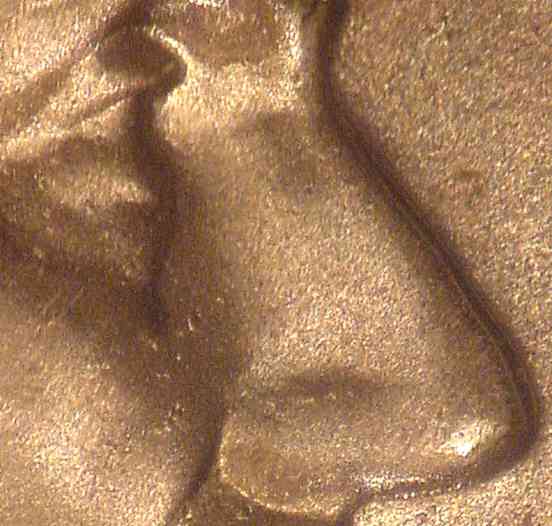
This is a portion, at full resolution, of a photo taken by the Sony camera in the above setup.
The object shown is a Lincoln penny, of which you are seeing part of Lincoln’s face.
I measured the features shown with calipers, giving a true height of the representation as 0.070 in.
The digital image is 526 pixels high.
Thus the system resolves about 7500 pixels/inch, which is 7.5 pixels/thousandth-inch, 130
microinches/pixel, or 3.4 microns/pixel.
If we assume your display renders 96 pixels/inch, then the effective magnification is
about 78x (= 526 pixels / 96 pixels/in / 0.070 in).
The camera resolves 1472 x 1104 pixels (not much by today’s standards),
so the camera and microscope can photograph a physical area of about 0.2 by 0.15 true inches at this level of detail;
the full field to the eye view in the microscope is about a 0.25 inch diameter circle.
The microscope field zooms from about 1 inch at 7x magnification, to 1/4 inch at 30x.
This is an amazing quality of result given that this camera sells for under $200, and the
microscope sells used for about $500. Such a system would have cost many $1000s, and required
costly film processing, not many years ago.
I don’t know the resolution limits of the microscope optics, but they’re probably better
than what the Sony DSC-S30 camera is resolving in this setup.
If that is true, then a higher-resolution camera would resolve more detail.
I have a much better digital camera now, but it uses a large-aperture lens that isn’t as
well-matched to the microscope aperture, resulting in a severe vignette in the image.
As a general optical design principle, one would want a small camera lens for this kind of
behind-the-eyepiece microscopy.
With camera lenses, bigger is usually better, since you can gather more light.
But digital cameras can (and typically do) have
very small, but nevertheless high-quality, lens systems, because the CCD electronic imaging
devices are so much smaller than film formats.
The light available is determined by the microscope optics, not the camera.
Many digital cameras today (2004) seem to be using imaging chips and lenses that are very close to
the human eye in physical scale. This is a wonderful thing for those wanting to adapt the cameras to
microscopes, because no optical adapters (such as a negative “relay lens”) are needed, just mechanical arrangements.
The pupil of the human eye may be assume to be about 4 to 5 mm in diameter when viewing microscope images.
A good microscope will provide an exit pupil of similar diameter, and the camera lens should match this as well.
Not so wonderful for the would-be photomicrographer is the trend away from putting filter mount
threads on the lens turrets, even on the more expensive consumer models; later versions of my Sony
DSC-S30 have a telescoping lens contraption that regrettably features no thread mount.
If you’re looking to buy a digital camera with hopes of photomicrography, look for one with a fixed, threaded
turret, with the inside thread diameter significantly larger than the microscope eyepiece you hope to use.
Even if your camera has an extending/retracting lens turret, you may find an optional adapter tube
(see Nikon, Canon, and Olympus examples below)
that provides both room for the turret and filter threads for a further adapter.
As a last resort, one can fit a sleeve machined just larger than the turret, with one or more screws for clamping
to the turret itself.